Energy bills in the UK remain significantly higher than they were three years ago, and for most homeowners that pressure isn't going anywhere soon. The good news: solar costs have fallen 90% in the last decade, and for the first time you can get a full, professional installation with £0 upfront. This guide cuts through the noise. Real numbers, what drives the price, and how Emerald Solar's all-inclusive Solar Plan makes going solar genuinely straightforward, whatever your budget.
1. How Much Do Solar Panels Cost in the UK in 2026?
The short answer: a typical UK home solar panel system costs between £6,500 and £10,000 for a cash purchase, depending on size. If you'd prefer not to pay upfront, Emerald Solar's Solar Plan lets you get started for £0 with monthly payments designed to be offset by your bill savings.
The table below gives a clear guide to typical costs and estimated annual savings by system size. These are all-in prices: panels, inverter, labour, scaffolding, DNO connection and EPVS performance validation included.
| System Size | Typical Home | Cash Cost | Annual Saving | Break-even |
|---|---|---|---|---|
| 3 kW | 1–2 bed | £5,000–£6,500 | £500–£700 | 8–10 years |
| 4 kW (most popular) | 3 bed | £6,500–£8,100 | £700–£1,000 | 7–9 years |
| 5 kW | 4–5 bed | £8,300–£10,200 | £900–£1,200 | 7–8 years |
| + Battery (9–10 kWh) | Any home | Add £5,000–£8,000 | Maximises savings | Review with installer |
Source: GreenMatch UK / Energy Saving Trust (2026). £0 upfront available via The Solar Plan with Hometree Finance.
These prices reflect the current 0% VAT rate on domestic solar installations, which applies until 2027 and saves homeowners up to £2,850 compared to the previous 20% rate.
2. What's Actually Included in the Price?
Not all solar quotes are equal. Understanding what is included, and what is not, is one of the most important things you can do before accepting a price.
What Emerald Solar's all-inclusive installation covers
- Premium solar panels (top-tier brands)
- Inverter (converts DC electricity from panels to AC for home use)
- All labour, scaffolding and fixings
- DNO application and grid connection, submitted on your behalf
- System monitoring app setup
- 2-year insurance-backed workmanship guarantee
- EPVS independent savings validation
- Up to 25-year maintenance, repair and replacement cover (via The Solar Plan)
What cheaper quotes often leave out
- Scaffolding, which can add £400–£800 to the final bill
- DNO application fee
- Post-warranty maintenance and repairs
- Long-term system monitoring
- Battery storage (frequently listed as an optional extra)
3. The True Cost of Solar: Is It Really That Expensive?
Most homeowners assume solar panels are a large, unaffordable investment. The reality in 2026 is rather different.
UK household energy bills currently average £1,500–£1,800 per year. A 4 kW solar system can cut that by 50–70%, saving between £700 and £1,000 annually, and that's without a battery. Add battery storage, and self-sufficiency increases to over 80%, further reducing grid reliance.
Homes with solar panels also sell for 3.5–7.1% more than comparable properties without them, according to a 2024 study published in Energy Economics, adding up to £19,000 in value on an average UK home.
£0 upfront with The Solar Plan
Monthly payments are designed to be offset by energy bill savings, making solar cost-neutral from day one for many customers.
4. What Affects the Price of Solar Panels?
System size (kW)
The larger the system, the more it costs, but the greater the annual savings. Emerald Solar sizes your system based on your actual energy consumption and roof space, not just bedroom count. A well-matched system is more important than a large one.
Battery storage
Adding a battery (typically 9–10 kWh capacity) costs an additional £5,000–£8,000, but significantly increases the proportion of solar energy you actually use. Without a battery, surplus daytime generation is exported to the grid via the Smart Export Guarantee. With one, that energy is stored for evening use, maximising your savings. Many homeowners choose a combined solar and battery package to get the best return.
Roof type and complexity
Standard tile or slate roofs have no additional cost. Flat roofs require angled mounting frames. Complex roof layouts with multiple pitches, dormers or obstructions increase installation time and therefore cost. Labour typically accounts for 25–30% of the total installation price.
Location
London and South East installers may charge a modest premium, but southern homes also generate more electricity annually, improving the return on investment. Emerald Solar operates nationally and uses EPVS-validated site data to give you accurate estimates for your specific location.
5. Are There Any Grants for Solar Panels in the UK?
There is no universal government grant for residential solar panels in England as of 2026. However, several financial incentives significantly reduce the effective cost:
- 0% VAT on solar installations, valid until 2027, saving up to £2,850 on a typical 4 kW system
- Warm Homes Plan, with ~£15bn committed to home energy improvements, with fully funded solar for low-income households
- Home Energy Scotland: interest-free loans for Scottish homeowners
- Wales Warm Homes Programme, which may cover solar for eligible Welsh households
- Smart Export Guarantee (SEG): earn 6p–30p per kWh for surplus electricity exported to the grid
6. The £0 Upfront Option: How Does The Solar Plan Work?
The biggest barrier to going solar has always been the upfront cost. The Solar Plan removes that barrier entirely.
Through Emerald Solar's partnership with Hometree Finance, you can have a full premium solar system installed with no deposit and no upfront payment. Monthly payments are spread over the plan term and designed to be offset by your energy bill savings, making the switch cost-neutral for most customers from the very first month. See our solar finance options for full details.
| Feature | The Solar Plan with Emerald Solar |
|---|---|
| Upfront cost | £0 deposit, £0 upfront payment |
| Monthly payments | Spread over plan term, designed to offset bill savings |
| What's covered | Equipment · Installation · Monitoring · Maintenance · Repairs |
| Finance application | 2 minutes online · Instant decision · No credit score impact (initial check) |
| Finance provider | Hometree Finance, FCA-authorised and regulated |
| Performance validation | EPVS-validated savings estimate included before you commit |
Finance is subject to status. Monthly payments are subject to a 2.5% annual increase. Missing payments could have severe consequences and make obtaining credit more difficult.
7. How Long Until Solar Panels Pay for Themselves?
For a cash purchase, the typical break-even for a 4 kW system is 7–9 years. With the Smart Export Guarantee included, this can shorten to 6–7 years. After that point, the electricity your panels generate is effectively free, and with a system lifespan of 25+ years, that means 16–18 years of near-free power.
Total estimated return over 25 years for a 4 kW system: £19,000–£32,000.
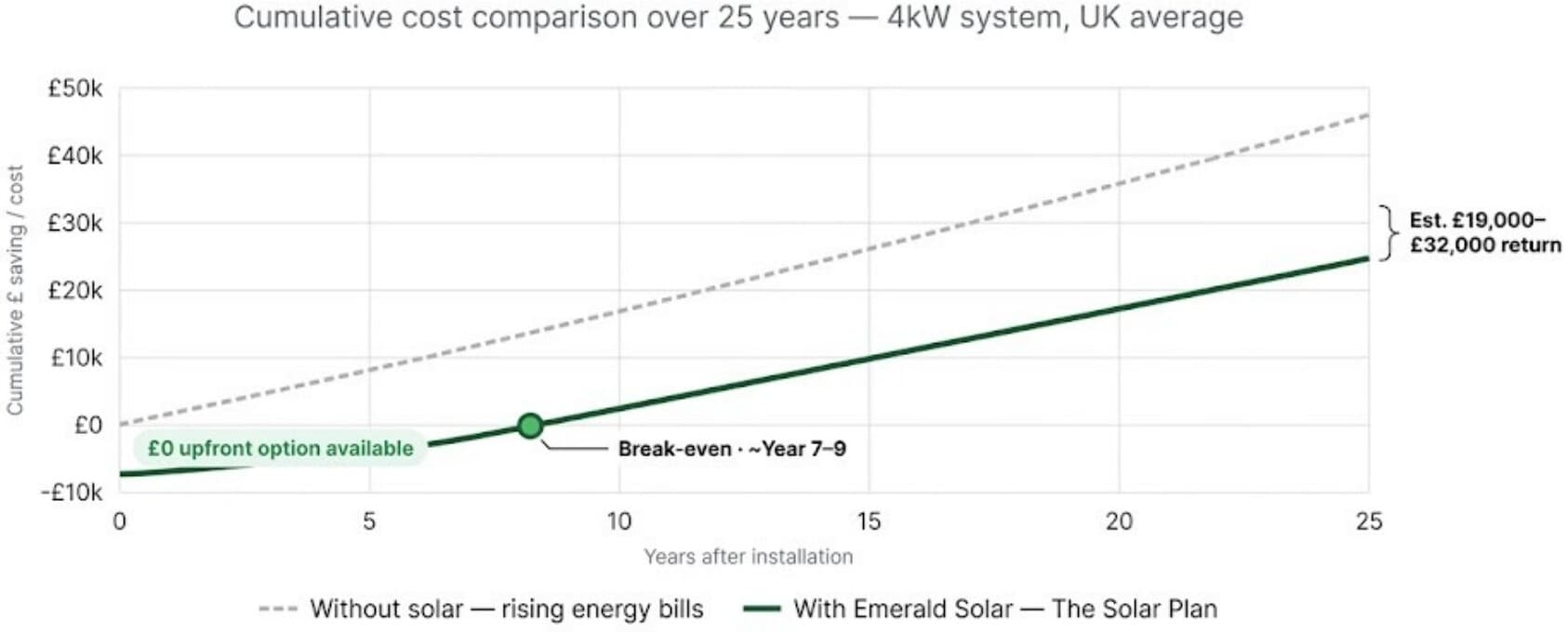
With The Solar Plan (£0 upfront), there's no break-even calculation. You start saving from month one. The question becomes how much you save, not when you'll recoup your investment.
8. FAQs: Solar Panel Costs UK
Are solar panels worth it in the UK in 2026?
Yes, for most UK homeowners. A typical 4 kW system saves £700–£1,000 per year, with a break-even of 7–9 years and a 25-year system lifespan. With Emerald Solar's £0 upfront Solar Plan, you start saving from the month of installation. The current 0% VAT rate (until 2027) further improves the economics.
How much do solar panels cost for a 3-bedroom house in the UK?
A 3-bedroom house typically needs a 4 kW solar system, costing between £6,500 and £8,100 in 2026, fully installed. This includes panels, inverter, labour, scaffolding and DNO connection. Adding battery storage costs £5,000–£8,000 extra.
Do I need planning permission for solar panels in the UK?
Most residential solar installations fall under permitted development rights and do not require planning permission. Exceptions apply to listed buildings, conservation areas and some flat-roof configurations. Emerald Solar confirms planning requirements during the free survey.
What is the cheapest way to get solar panels in the UK?
The lowest-cost route without a large upfront payment is a finance plan such as Emerald Solar's Solar Plan. For outright purchase, 0% VAT (until 2027) reduces costs by up to £2,850. Low-income households may also be eligible for Warm Homes Plan support.
9. Ready to See Your Numbers?
Every home is different. The numbers in this guide are averages. Your actual savings depend on your roof, your energy usage, your location and the system size that's right for you. Emerald Solar's free quote comes with an EPVS-validated savings estimate, so you'll see exactly what your system could save before you make any decision. No commitment. No upfront cost. No pressure. Prefer to talk it through? Get in touch with our team and we'll be happy to help.